Every page of this site converges here, and not by chance, since understanding quantum computers, algorithms and applications serves one purpose only, making good decisions. Quantum readiness is exactly this, the capacity of an organisation to govern the impact of quantum technologies instead of being subjected to it, protecting what needs protecting today and preparing what will create value tomorrow.
This page describes the complete path, assessment, training, proof of concept in emulation and roadmap, with timescales, realistic costs and success criteria, that is, the method with which HumanQ can accompany businesses and institutions from the first inventory to strategy, through to the training of experts and the development of quantum research algorithms. Quantum readiness, understood in this way, is a project with a beginning and an end, not a feeling of hypothetical risk in the face of uncertainty.
What is quantum readiness?
Quantum readiness is a measurable organisational state, made up of three capabilities.
- Defensive capability. Knowing which data and systems are exposed to the quantum cryptographic threat and having a migration plan with priorities and deadlines.
- Cognitive capability. Having in-house the resources and skills needed to read the sector critically, evaluate suppliers and tell demonstrated advantage from announced advantage.
- Project capability. Having identified the business processes with the right computational structure and having prototyped them with comparison baselines, so as to have your own numbers for developing prototypes in emulation right away and being even more ready when the hardware matures.
Being quantum ready does not require owning a quantum computer, nor predicting its timelines, but it does require having the knowledge and culture to be ready for any next scenario, which is the very definition of strategy.

Why move now if the hardware is not yet mature?
It pays to move now because of three time asymmetries documented across this whole site. The first is that the cryptographic threat is already active, since the ‘harvest now, decrypt later’ strategy exposes every piece of long-lived data today, and regulators have already set deadlines for the post-quantum migration. The second is that skills mature more slowly than hardware, because training a team that can formulate problems and read results takes years, and it can be done entirely in emulation, without waiting for anyone. The third is that competitive advantage is built in the preparation phase, because when a technology becomes available to everyone, the differentiator lies with those who already know how to use it on their own problem. Waiting for maturity means, literally, choosing to arrive together with the last.
How does the initial assessment work?
The assessment is a double inventory, conducted in parallel on different fronts. On the defensive front, a census is made of the cryptography in use, in the organisation’s own systems and in the supplier chain, with data classified by useful life and exposure calculated according to the logic of Mosca’s theorem, and the output is the list of migration priorities, often also required for compliance.
On the opportunity front, the processes with combinatorial, stochastic or simulation problems whose complexity explodes as the variables increase are mapped, quantifying the current baseline, that is, how much it costs today to solve them with the best classical methods.
The overall output is a truthful picture of what to protect immediately, what to prototype soon and what merely to monitor. Many organisations discover here that half of the work is already an obligation, not a choice.
What training does the team need?
Less training is needed than people fear, but more targeted than they think. The path that experience has selected distinguishes three profiles.
- Decision-makers. A few hours to master the map and its optimal path: what is proven, what is promising, what questions to ask a supplier.
- Domain specialists, such as analysts, engineers and computational chemists. Weeks of guided practice in emulation, from the fundamentals of the qubit to variational algorithms run on their own problem, because quantum algorithms are learned by running them.
- Security teams. Operational understanding of the threat, including running Shor’s algorithm on reduced instances, which turns migration from a formal obligation into a well-defined, well-understood project.
The aim is not to create theoretical physicists, but to create competent professionals.
How do you choose the use case for the proof of concept?
The choice is made with the three-question filter applied to the candidates that emerge from the assessment, that is, the right computational structure, a quantified classical baseline and the economic value of the improvement. To the filter are added common-sense project criteria, such as an instance that can be reduced without distorting it, data available without confidentiality obstacles and an in-house analyst who will use the results. The ideal candidate is a real but circumscribed problem, the optimisation of a line, the pricing of a family of instruments, a molecule representative of the portfolio, not the company’s biggest problem. The most common mistake is ambition, because a proof of concept that wants to prove everything proves nothing, while a well-delimited one produces defensible numbers and a replicable method.
How is the proof of concept run in emulation?
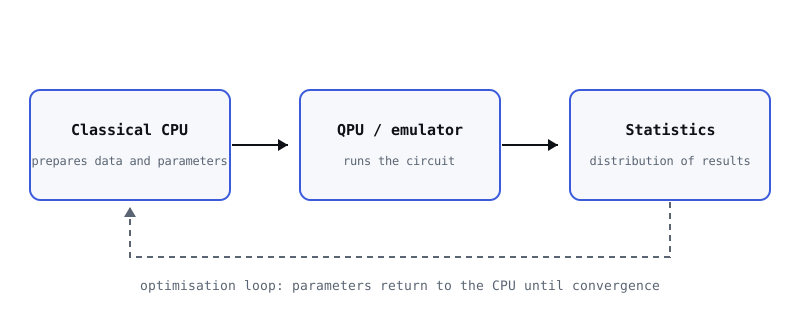
The proof of concept follows a by now standard cycle, entirely on the quantum emulation platform, divided into four phases.
- Formulation. The business problem is translated into quantum form, QUBO for optimisation, Hamiltonian for simulation, with the classical baseline implemented alongside it.
- Execution. The algorithm runs in emulation at increasing sizes, with every quantity inspectable and every run reproducible, also activating if needed calibrated noise models to estimate behaviour on future real hardware (today it is also possible to emulate quantum noise, that is, the noise of the hardware).
- Measurement. Systematic comparison with the baseline at equal quality of result, on time, cost, accuracy and scalability.
- Verdict. Either the potential advantage exists under certain hardware conditions, or it is not yet sustainable, but with numerical evidence to demonstrate it.
The typical duration is a few months, and both outcomes are a success, because both steer the strategy with the company’s own data.
What does the final roadmap contain?
The roadmap translates the results into a multi-year plan, across three horizons.
- Immediate horizon. The cryptographic migration programme with priorities, suppliers involved and deadlines aligned with regulatory obligations, plus the sector monitoring function, a few trained people with the mandate to read and evaluate progress.
- Medium horizon. The extension of successful proofs of concept, the integration of quantum pipelines alongside classical ones, partnerships with the ecosystem, from research to suppliers to national infrastructure such as HumanQ and the Italian Quantum Emulation Centre (Centro Italiano di Emulazione Quantistica).
- Long horizon. Investment triggers, that is, measurable conditions, such as error rates, available logical qubits and access costs, on the occurrence of which decisions already prepared are triggered.
A roadmap built in this way does not predict the future but masters it, and awaits it prepared.
How much does it cost and how long does it take, realistically?
The path costs less than the subject makes one fear, for a structural reason, since emulation eliminates the heaviest item – access to quantum hardware – and makes everything proportionate.
The first complete cycle, with assessment, targeted training, a proof of concept and a roadmap, is measured in months, not years, and in pilot-project budgets, within reach of a small or medium-sized enterprise (no longer only for large groups). The return has two certain components and one potential one, because cryptographic compliance started in good time avoids the costs of emergency migrations, the in-house skills remain in the company in any case (sovereignty over your own data), and any computational advantage discovered would by itself justify the investment.
The numbers show that quantum readiness is a strategic insurance capable of generating value from the start, a rare case indeed among technology investments.
Which mistakes should be avoided along the way?
Observation of the market yields a few typical mistakes.
- Buying before understanding. Hardware access and licences subscribed to without a filtered use case produce demos, not decisions.
- Ignoring the defensive front. Funding computational exploration while neglecting cryptographic migration inverts the priorities, because the latter is an obligation with a deadline.
- Delegating everything. Without in-house skills, even minimal ones, the company cannot evaluate what it receives, and readiness remains on the supplier’s paper.
- Believing claims without a baseline. Every announced advantage must be checked against the best classical method, on your own problem, with your own data.
The path described on this page is built, point by point, to make these mistakes impossible.
What can HumanQ do for your company’s competitiveness?
HumanQ’s contribution goes beyond the single project, because the underlying aim is to bring a lasting quantum culture into the company, that is, the widespread capacity to understand where these technologies touch one’s own business, to talk about them with authority with customers and suppliers and to recognise opportunities before competitors. It is from this culture, more than from any single technology, that lasting competitive advantage arises. On this basis, HumanQ operates on four concrete levers.
- Quantum culture and training. Differentiated paths for decision-makers, specialists and security teams, from the fundamentals to guided practice, because a company that understands quantum can evaluate, negotiate and decide without depending on other people’s judgement.
- Development of quantum-ready databases. Company data are structured, cleaned and organised so that optimisation and simulation problems can be formulated rigorously, work that immediately improves classical analytical processes as well and prepares the ground for tomorrow’s algorithms.
- Quantum emulation. By using quantum emulation, the company runs, inspects and repeats quantum circuits on classical infrastructure, turning experimentation from a speculative cost into a controlled laboratory, with reproducible results that can be compared over time.
- Development of bespoke quantum algorithms. From the formulation of the business problem to the prototyping of the algorithm, with the classical baseline always alongside, so that every step forward is measured on the company’s own real case and becomes the company’s intellectual property, not the supplier’s.
The four levers reinforce one another, because culture makes data useful, data feed emulation, emulation validates algorithms and algorithms, measured on the company’s own business, return competitiveness. A company that activates them together is not buying technology, it is building a capability that competitors will have to chase.
How does the journey with HumanQ start, in practice?
The journey begins with a first analysis meeting, with no commitment, in which the two inventories are delimited and the candidates for the proof of concept are identified. The assessment proper follows, with interviews with process and security contacts, and closes with the picture and the priorities. From there training and proof of concept in quantum emulation start according to the cycle described above, through to the roadmap.
HumanQ brings the method, the experience on use cases, from defence to healthcare to finance, through to the emulation infrastructure, while the company brings the problem and the people to be trained, and retains ownership of the results, because the quantum readiness that remains is the one built in-house, not the one that is rented. It is this division of labour that makes quantum readiness an ordinary innovation project, with a beginning, an end and measurable results, exactly what this subject, stripped of hype, deserves to be.
Start your quantum readiness journey
Quantum culture, quantum-ready databases, emulation on the EQM platform and development of bespoke algorithms, with HumanQ accompanying you at every step, with numbers and method, to turn preparation into competitiveness. Contact the HumanQ team for the first scoping meeting, or start from the fundamentals with the guide to quantum emulation.